United States · Fractional Currency · Fifth Issue
10 cents note, 1874
10 cents · Fractional Currency · Series of 1874
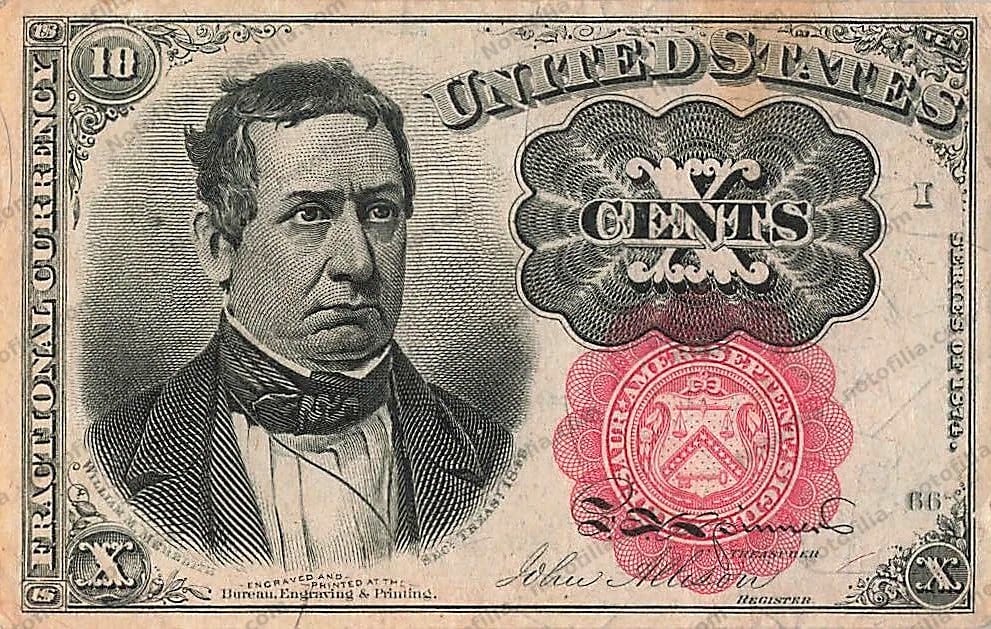
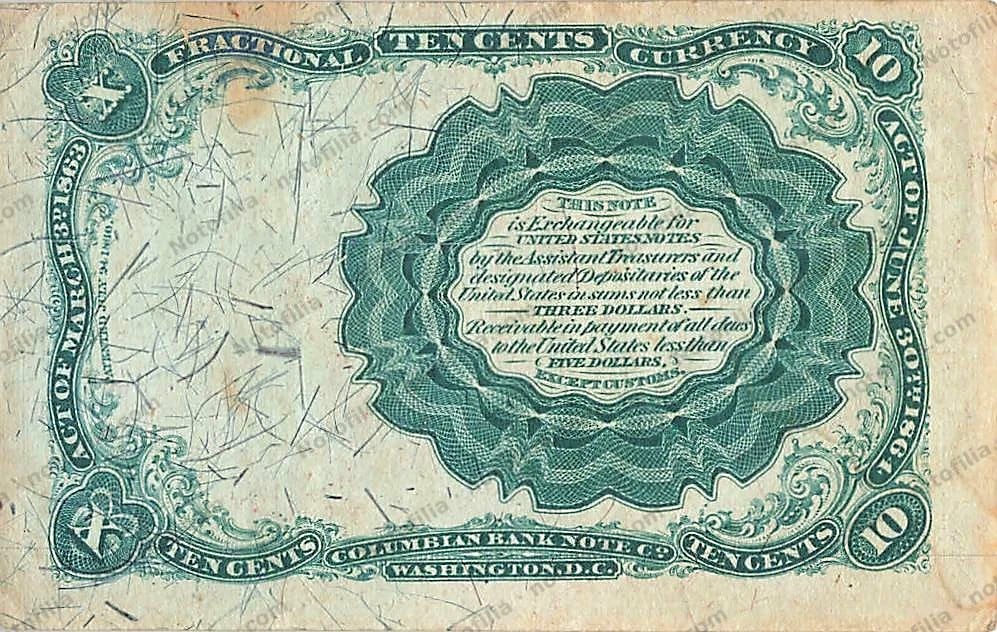
A Fifth Issue 10¢, Series of 1874: portrait of William M. Meredith, red seal, Allison–Spinner signatures, and a Columbian Bank Note Co. reverse. No printed serial.
Catalog facts
- Friedberg reference
- Fr. 1265 o Fr. 1266
- Serial number
- —
- Issue
- Fifth and final Fractional Currency issue
- Portrait
- William M. Meredith, Secretary of the Treasury (1849–1850)
- Treasury seal
- Red (rules out green-seal Fr. 1264)
- Friedberg variety
- Fr. 1265 (long, thin key) or Fr. 1266 (short, thick key); not confirmed from this photograph
- Face printer
- Bureau of Engraving and Printing
- Reverse imprint
- Columbian Bank Note Co., Washington, D.C.
- Legal authority
- Acts of 3 March 1863 and 30 June 1864
- Colors
- Black and red face; green reverse
- Signatures
- John Allison (Register of the Treasury) and Francis E. Spinner (Treasurer of the United States)
- Condition
- Circulated, unslabbed (private collection)
- Dimensions (mm)
- ≈ 83 × 54
- Paper
- Paper with visible security fibers (blue and red).
- Printing method
- Intaglio: BEP face; Columbian Bank Note Co. reverse.
- Inks
- Black and red face; green reverse.
- Printage
- Fifth Issue, Series of 1874: circulated from 26 February 1874 through 15 February 1876 (BEP, Currency Notes; Fractional Currency fact sheet). The BEP estimates the face value of all Fractional Currency at $368,720,079.51 and of the Fifth Issue at $62,661,900.00; those are face-value totals, not a note count. This record does not invent a printage for Fr. 1265, Fr. 1266, or for this piece.
Face
Back
The note
The 10¢ P#122 (Numista N#203351) is the low denomination of the United States Fifth Issue of Fractional Currency, the last of the five federal issues of paper under one dollar. The face, black and red on paper with visible security fibers, carries at left the portrait of William M. Meredith — Secretary of the Treasury in 1849–1850 — with the legend WILLIAM M. MEREDITH and SEC’Y TREAS’Y 1849. At right, UNITED STATES crowns a medallion with the Roman X and CENTS; FRACTIONAL CURRENCY runs vertically on the left border, and SERIES OF 1874 on the right. The face imprint reads ENGRAVED AND PRINTED AT THE Bureau, Engraving & Printing. Below, John Allison (REGISTER) and F. E. Spinner (TREASURER) sign, the latter over the red Treasury seal (THESAUR. AMER. SEPTENT. SIGIL.). The green reverse carries the exchange text for United States Notes in sums not less than three dollars and for dues to the United States less than five dollars, except customs; the borders cite the acts of 3 March 1863 and 30 June 1864; at bottom, COLUMBIAN BANK NOTE CO. WASHINGTON, D.C. There is no serial field: the type does not print one. The red seal rules out green-seal Fr. 1264; between Fr. 1265 (long, thin key in the seal) and Fr. 1266 (short, thick key) this photograph does not confirm the variety. It is not the Robert J. Walker 25¢ or the William H. Crawford 50¢ of the same issue. The collection note, circulated and unslabbed, is shown in a sleeve.
Paper change when coin vanished
At the start of the Civil War the public hoarded silver and gold, and everyday trade lost its change. Congress, on 17 July 1862, authorized postage and other stamps for debts to the government; that emptied the stamps. Notes under one dollar followed — Postage Currency — with designs taken from the stamps; later issues, looking more like banknotes, were called Fractional Currency, authorized on 3 March 1863. Between 1862 and 1876 there were five issues, from 3¢ to 50¢. The BEP dates to 1863 the first currency produced entirely at the Treasury.
The Fifth Issue, introduced on 26 February 1874, narrowed the set to three values: 10¢ (Meredith), 25¢ (Robert J. Walker), and 50¢ (William H. Crawford). Production ended on 15 February 1876, as metallic coin returned to circulation; Congress later authorized redemption of that paper in silver coin. The BEP estimates the face value of all five issues at $368,720,079.51 and of the Fifth at $62,661,900.00. The Smithsonian National Numismatic Collection confirms the portrait, issue period, design, and printer inscriptions; its specimens measure about 83–85 × 53–54 mm.
Scarcity and printage
Numista groups Fr. 1264–1266 under N#203351 and, among its members, places Fr. 1265 (red seal, long key) at about 83 percent of holdings of the type against 13 percent for Fr. 1266 (short key) and 4 percent for Fr. 1264 (green seal). That frequency measures members’ collections, not auction supply. This record does not invent a census or an auction rarity for this piece, nor a printage by Friedberg variety.
Population
A PMG or PCGS census for this unserialed example has not been independently verified. The note is shown in a sleeve, unslabbed, with no certificate number.
What this entry does not claim
- This record does not confirm whether this piece is Fr. 1265 (long key) or Fr. 1266 (short key); only the red seal is asserted.
- No printage is invented for Fr. 1265, Fr. 1266, or for this piece; the BEP totals are face value for the whole issue.
- No price and no grading census are published.
- The ≈ 83 × 54 mm dimensions are approximate; the Smithsonian records slight variation among specimens.
Sources
- BEP — History Fact Sheet: Fractional Currency (April 2013) (opens in a new tab)
Five issues, 1862–1876; Fifth Issue 10¢, 25¢, and 50¢; estimated face-value totals (Fifth $62,661,900.00; overall $368,720,079.51).
- BEP — Currency Notes (PDF) (opens in a new tab)
Fifth Issue dates: 26 February 1874 – 15 February 1876; acts of 1862 and 1863.
- Smithsonian NNC — 10 Cents, Fractional Currency, 1874–1876 (nmah_1671430) (opens in a new tab)
Meredith portrait; Fifth Issue; BEP and Columbian Bank Note Co. imprints; measurements ~5.4 × 8.4 cm. Not this piece.
- Numista — N#203351, 10 Cents Fractional Currency, 5th series (opens in a new tab)
P#122; Fr. 1264–1266; Allison–Spinner signatures; member frequencies by seal and key variety.
- Wikipedia — Fractional currency (opens in a new tab)
Variety table: Fr. 1264 green seal; Fr. 1265 red seal, long thin key; Fr. 1266 red seal, short thick key.
Related pieces
Other records from the same issuer or era in this case.