Netherlands East Indies · VOC · Utrecht
1 duit coin, 1790
1 duit · VOC · 1790
VOC copper duit, Utrecht, dated 1790. NGC Genuine, certificate 8703937-175, Old New York label.
Catalog facts
- Year
- 1790
- Mint
- Utrecht, for the Netherlands East Indies (VOC)
- Denomination
- 1 duit (1/8 stuiver)
- Composition
- Copper
- Weight
- Not weighed. Numista type figure: 3 g. That weight is not assigned to this piece.
- Diameter
- Not measured. Numista type figure: 22 mm.
- Edge
- Plain (type). The edge was not photographed loose; the arms side shows a rim nick.
- Condition
- NGC Genuine
- NGC certificate
- 8703937-175
- References
- KM# 111 · Scholten 656 y ss. · Numista N# 6585
Obverse
Reverse
The coin
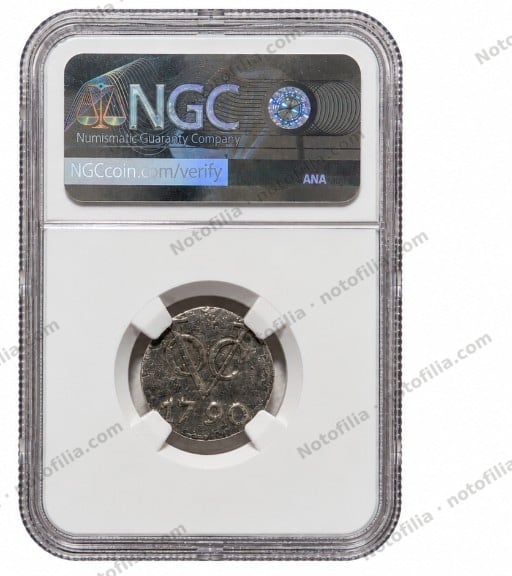
This copper duit — one eighth of a stuiver — was issued by the Vereenigde Oost-Indische Compagnie for the Netherlands East Indies, with the arms of the city of Utrecht. The obverse carries the interlocked VOC monogram and, below it, the date 1790, readable in the photograph. Above the monogram the mintmark is worn: neither the shield between dots of the contemporary type (KM# 111.1, Scholten 656 family) nor the star of the later official restrikes that kept the 1790 date (KM# 111.3, star between dots; KM# 111.4, star alone) can be told apart. The record cites KM# 111 without a subtype. It is not the civic duit lettered STAD UTRECHT. Numista groups the type as N# 6585: copper, 22 mm, 3 g, plain edge, medal alignment. The copper is dark and uneven, with porosity and a rim nick on the arms side, consistent with an authentic piece that receives no numeric grade.
Legends
- Obverse
- VOC / 1790. The monogram abbreviates Vereenigde Oost-Indische Compagnie. The mintmark above the monogram is worn and is not transcribed.
- Reverse
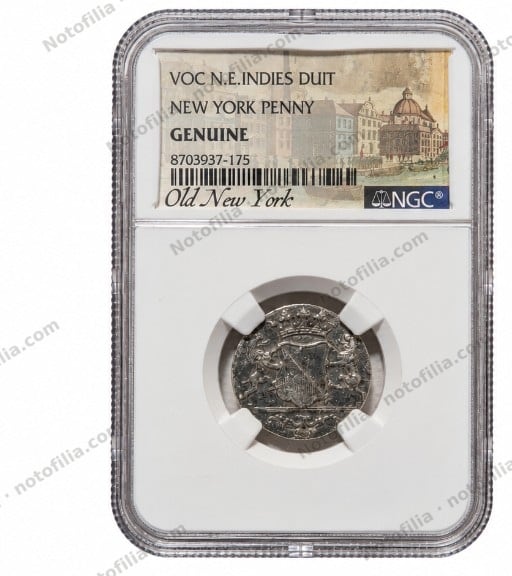
- Crowned shield of the city of Utrecht, held by two lions, with scrollwork in the exergue. It does not carry the STAD UTRECHT legend of the civic duit.
History
The VOC, founded in 1602, struck copper duits as small change for the East Indies. Collectors and NGC call that series the New York Penny, and the pictorial Old New York label was made for that market: Company duits did circulate in New Netherland when English copper was scarce. New Amsterdam passed to England in 1664. A piece dated 1790, and still more a later restrike that keeps that date, was not circulating in Dutch New Amsterdam. The nickname is traditional; it is not a separate colonial emission. The Company was dissolved in 1799. Official mints afterwards restruck duits dated 1790 with a different mark above the monogram. That mark is not resolved in this photograph.
Scarcity and type
The Utrecht duit dated 1790 is a common copper of type KM# 111. Numista is not cited here as a census of this certificate. The worn mintmark prevents separating the contemporary striking from the nineteenth-century official restrikes that repeat 1790.
Certification
NGC accepted the piece as an authentic VOC duit and did not assign a numeric grade. Genuine records surface problems — corrosion, porosity, scratches, or environmental damage — typical of the series. The holder, from the Old New York series, reads VOC N.E. INDIES DUIT, NEW YORK PENNY, GENUINE, and certificate 8703937-175. The public check is that number at ngccoin.com. This record transcribes the visible label; it does not publish a population census.
Sources
- NGC — Certificate lookup 8703937-175 (opens in a new tab)
The label visible on the holder reads VOC N.E. INDIES DUIT, NEW YORK PENNY, GENUINE, and 8703937-175.
- Numista — 1 duit, Utrecht (N# 6585) (opens in a new tab)
Utrecht type, 1741–1794, KM# 111 and Scholten 656 and following: copper, 22 mm, 3 g, plain edge, medal alignment. The date 1790 also appears on later official restrikes, separated by the mintmark.
- Wikipedia — Dutch East India Company (opens in a new tab)
Company founded in 1602 and dissolved in 1799. It struck coin for overseas trade.
- Wikipedia — New Amsterdam (opens in a new tab)
The Dutch settlement passed to England in 1664, before VOC duits dated 1790.
Related pieces
Other records from the same issuer or era in this case.