Issuing
Provisional note
Billete provisional
A provisional note is an emergency, temporary-circulation issue produced to cover a shortage of cash while definitive paper is prepared. It is not German Notgeld by itself — that is the European 1914–1924 case — nor a remainder that never left the vault. A provisional note does circulate, with a date or overstamp that marks it as a bridge. In Colombia the canonical episode is the opening of the Banco de la República on 23 July 1923: the run on Banco López brought forward the date planned for 1924, and the government had gold certificates engraved by the American Bank Note Company brought from the Medellín mint to be overstamped in a weekend.
Those certificates, as the Colombian case records, travelled by rail to Puerto Berrío, seaplane to Girardot, and train to Bogotá. The back received the stamp “BANCO DE LA REPÚBLICA — BILLETE PROVISIONAL.” The overstamp revalidated paper already printed; a new plate was not engraved in those days. Hernández and BanRep sources distinguish that bridge from the first regular ABNC issues, which already carry the peso oro legend. No 1923 serial is published here: this collection does not yet record one of those overstamped certificates.
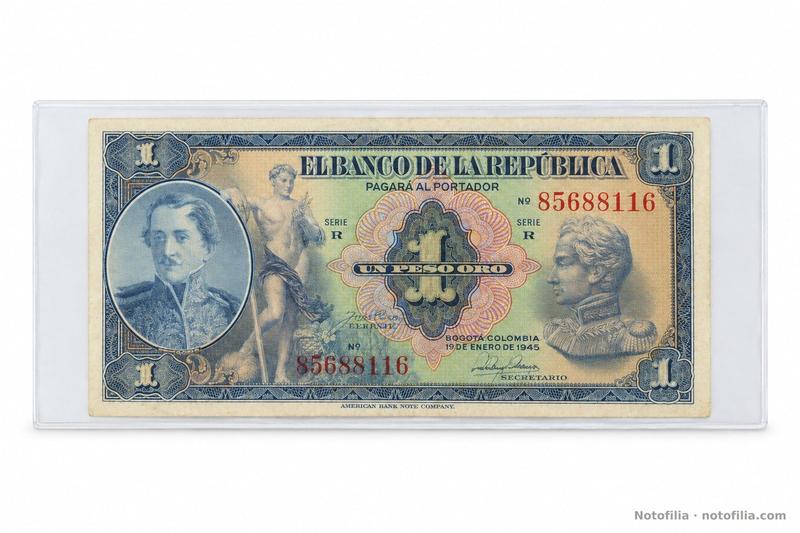
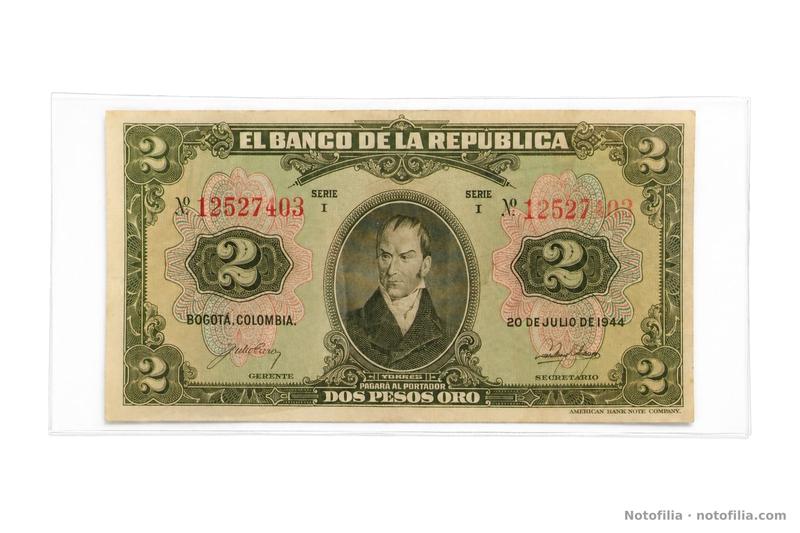
The term helps in reading other crises: sovereign-state paper in the Thousand Days’ War, lazaretto tokens, or Puerto Rico’s 1895 exchange note, a receipt while foreign silver was withdrawn. None of those objects is a specimen or a proof. When a later record — a 1945 1 peso oro, a 1944 2 pesos oro — cites peso oro, it is speaking of the regime that began after that 1923 bridge, not of the Medellín overstamp.
Examples in the collection
See also: Floating debt note , Notgeld / emergency money , Countermark