Issuing
Free banking
Banca libre
Free banking is the regime in which several private banks issue their own circulating paper, without a single central bank holding the note-issue monopoly. In Colombia it covers the decades after independence until the Banco Nacional and, later, the Banco de la República (1923) consolidated the privilege. Each house — mortgage, commercial, or regional — ordered plates from New York or London engravers and promised payment to the bearer in current money. The risk was the bank’s: if it failed, the paper lost convertibility. It is not the same phenomenon as municipal scrip or as a provisional note of an already central institute.
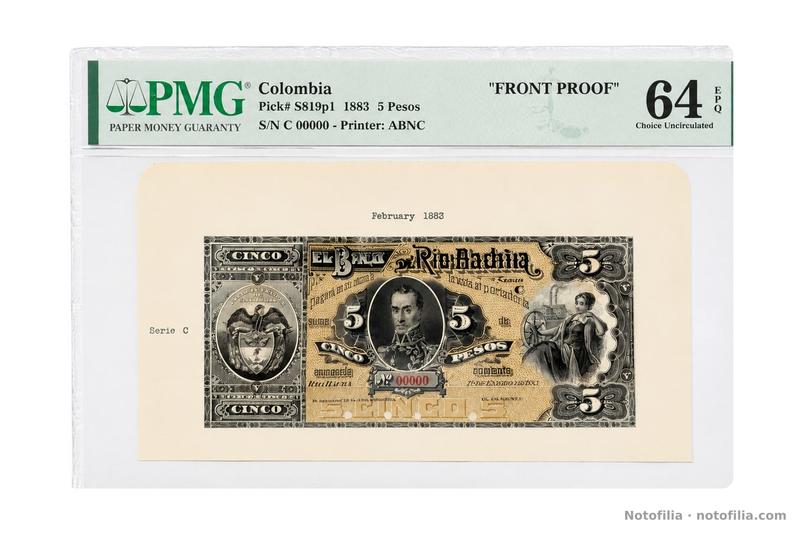
Catalogues treat that paper as specialized issues (Pick S, Hernández Cód. for private banks), not as Banco de la República types. González White begins in 1923; for Riohacha, the Hipotecario, or Tolima one reads Hernández and, as auction comparables, the Heritage extract, without importing lots or republishing prices. An ABNC proof with zero serials is not the circulating note: it is a printer’s object, often uniface or a face/back pair, distinct from a central-bank specimen marked SPECIMEN.
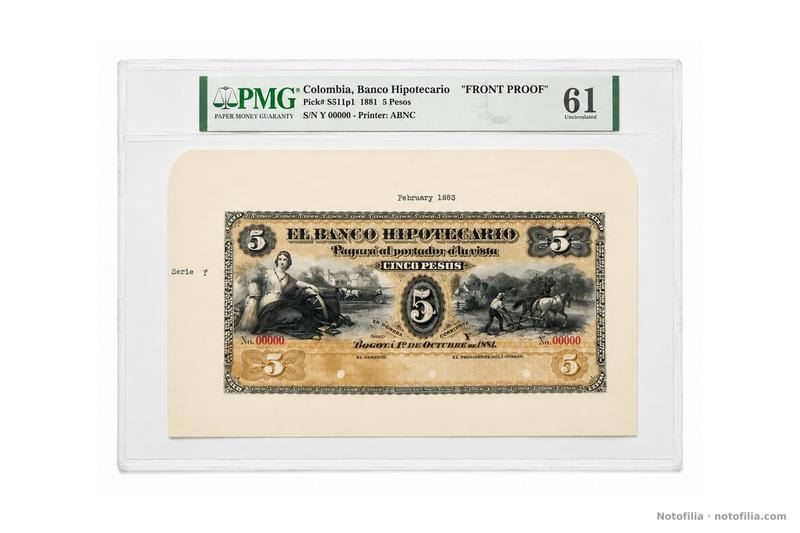
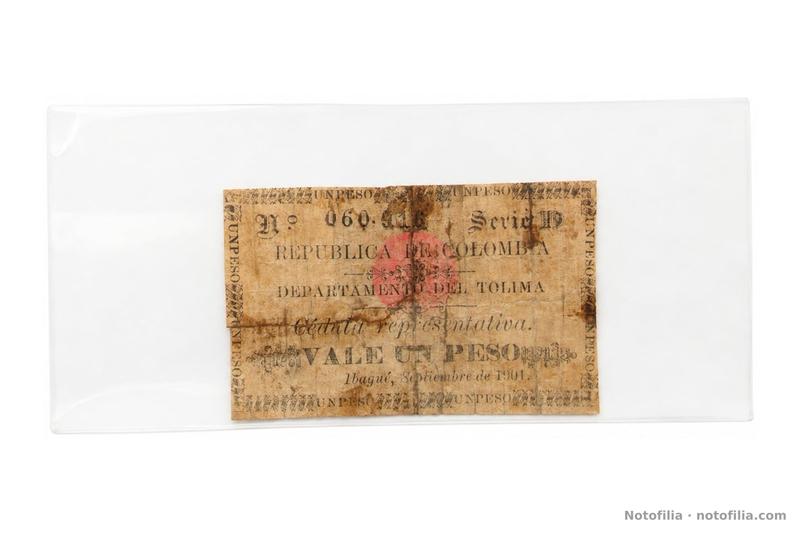
This collection records three Colombian houses of that period. The Banco Hipotecario 5 pesos (1 October 1881) is an ABNC proof pair, Series Y, serial 00000, slabbed PMG 61. The Banco de Riohacha 5 pesos (1883) is another proof pair, Series C, serial 00000. The 1901 Banco del Tolima 1 peso is paper of a sovereign state at war, not of a Bogotá mortgage bank. None of the three is a BanRep Pick; each piece’s identity remains its serial or, on the proofs, the plate–zero pair.
Examples in the collection
See also: Issuing bank / authority