Design
Obverse
Anverso
The obverse is the front of a banknote: the face the issuer treats as primary. On modern paper it usually carries the portrait or highest-ranking motif, the bank’s name, the promise to pay, and often one of the two serials. It is not an automatic synonym for “the portrait side”: the Bank of England prints the promise and the royal portrait on one face and reserves the back of this collection’s polymer £5 for Churchill. On coins the obverse is the effigy or issuing-authority side.
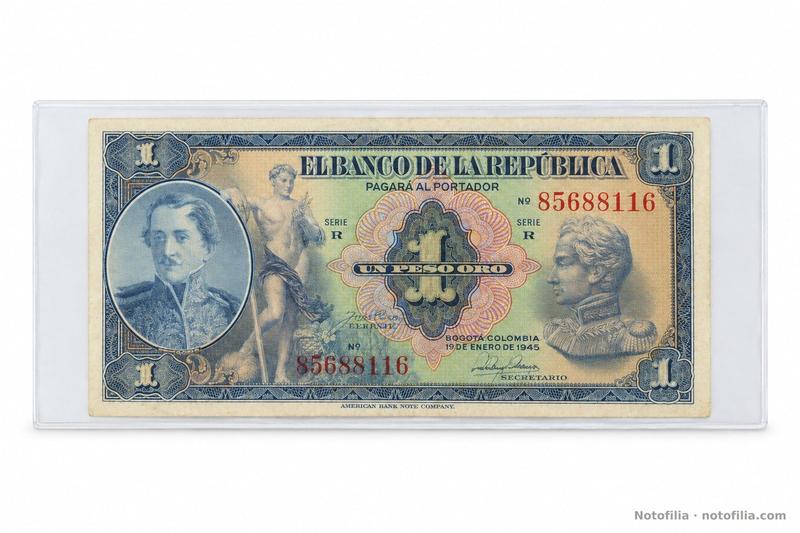
The convention matters when describing a record. A cutting error, a stamp, or a serial may sit on only one face; naming obverse and reverse avoids ambiguity. On Banco de la República paper the face concentrates the manager’s signatures and, on many dates, the printed date; the back carries the building, the scene, or the map. Vietnam military payment certificates are offset lithography on both sides, with no intaglio, and still have a use face and a simpler-coloured back.
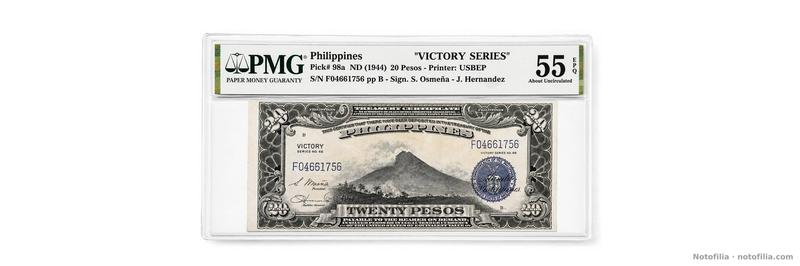
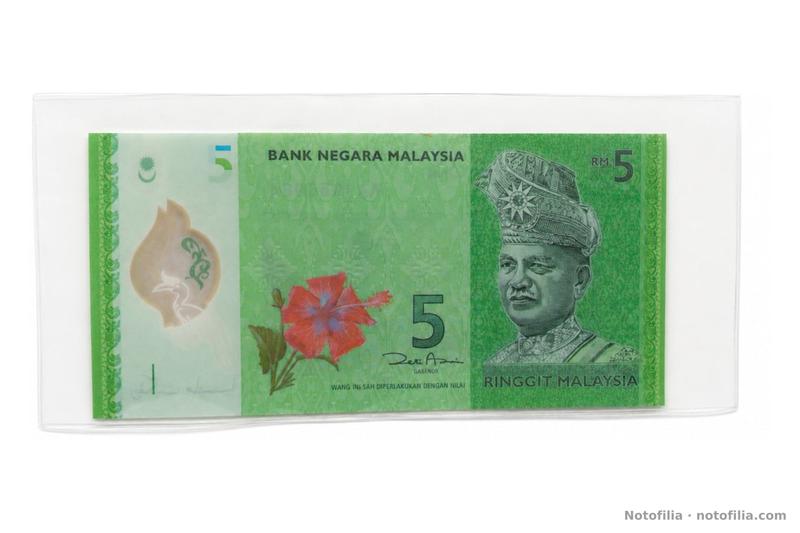
In this collection the obverse is photographed first and described with the serial that identifies the piece. The 1945 1 peso oro shows Santander and Bolívar on the face, serial R 85688116. The Philippine Victory 20-peso note carries Mount Mayon on the obverse, not a portrait. The Malaysian RM5 places Tuanku Abdul Rahman at right and the clear window at left. None of those faces is “the more valuable side” on its own: the object is the whole sheet, obverse and reverse together. The glossary keeps reverse as a sibling article, so a back is not described as if it were the face.
The obverse is also where the collector reads signatures, date and, on many Colombian types, the engraver’s imprint. A record that omits that face does not identify the object. That is why each example in this article links the published face photograph, not a new crop or an invented serial.
Examples in the collection
See also: Reverse