Published
Source: Heritage Auctions (opens in a new tab)
A 1762 Santa Fe 8 reales sells for US$195,200
Heritage Auctions sold the 1762 NR-JV pillar dollar (PCGS AU50) in the ANA Platinum Session, auction #3135: US$195,200, about COP 627 million at the 1 September TRM.
- Reviewed by
- Yezid Acosta
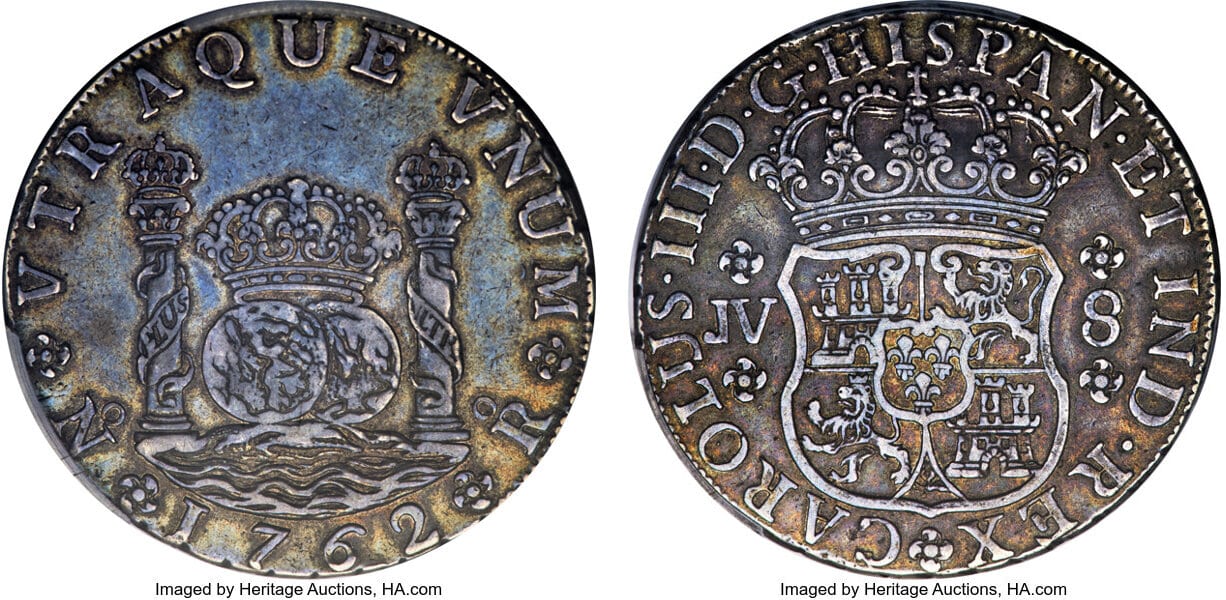
Two hundred and sixty-four years after it left the dies of the Santa Fe mint, a silver disk of 38 millimetres changed hands again. It was 1 September 2026, at the ANA World & Ancient Coins Platinum Session and Signature Auction #3135 of Heritage Auctions (1 to 5 September). Lot 33121 — an 8 reales of Charles III, dated 1762, mintmark NR of Nuevo Reino, assayer JV, encapsulated by PCGS at AU50, certificate 37262548 — closed at US$195,200.
The hammer fell at US$160,000; the rest is the buyer’s premium. At that day’s Superintendencia Financiera de Colombia TRM, COP 3,213.97 per dollar, the figure is about COP 627 million (COP 627,366,944).
It is worth saying at the outset what the figure is not. It is not the price of a pillar dollar: there are Mexican and Lima pieces a patient collector can find on a good fair day. It is not a valuation of the example the Bogotá museum holds, which is not for sale and will not be. It is the result for this example, in this session, in this grade.
The silver Santa Fe almost never learned to make
The design is the pillar dollar of the two worlds: the Pillars of Hercules cinched with Plus Ultra, and between them the two globes, the Old World and the New, held as if the empire could be carried in the hands. It is the type Mexico and Lima struck in floods for decades. It is also the type that in Santa Fe barely showed itself.
The Nuevo Reino mint was a gold house. The metal that came down from the mines to the sabana, the metal that occupied the workmen and justified the drafts, was gold; milled silver in Bogotá was an administrative rarity more than a habit. That is why the permanent-exhibition booklet of the Casa de Moneda Museum (opens in a new tab) (1996) pauses precisely on a patacón of 8 reales of 1762, 38 mm, and calls it an “almost unique Santa Fe coin.” It is not a dealer’s phrase. It is the record of a gap in the cases.
Heritage references the example as KM-39, Calicó 1198 — this same coin — and Restrepo 44.1. We do not publish a 1762 mintage here: the Banco de la República’s metallic-production tables begin in 1987 and do not reach colonial silver. When the figure does not exist, an honest catalogue says so.
Two examples, and only one travels
Heritage’s catalogue treats two as accounted for. One rests in the Casa de Moneda Museum in Bogotá, plated by Restrepo and by Barriga Villalba. The other is this one, published by Domingo de Irigoyen in the Gaceta Numismática in 1972 and later taken up as a Gilboy plate.
One stays still. The other is the one that moves. At public auction it has moved twice in a quarter-century: Numismatica Ars Classica 22, March 2002, lot 334; and Aureo & Calicó 304, January 2018, lot 78. That itinerary — fifty years of bibliography and three documented appearances — is worth as much as the silver. In a series where fakes and optimistic attributions abound, a long, verifiable provenance is the only guarantee a buyer can take home.
A necessary clarification: the piece does not belong to Notofilia’s virtual collection. We cite it as an auction comparable.
What the hammer bought
Heritage estimated US$100,000–150,000 and opened at US$50,000. The realized price sat above the high band.
The grade helps to explain why. AU50 on the Sheldon scale is about uncirculated: the coin circulated, but not much. There is wear only on the high points of the relief, original luster remains in the recesses, and the house catalogue describes polychrome patina in the fields, that slow rainbow silver only earns if nobody cleans it for two centuries. It is, in practice, a Santa Fe pillar dollar that survived use and the good intentions of its owners.
But conservation alone did not pay the price. Arithmetic did: Santa Fe almost never struck this type, the other known example does not come to market, and the one that does arrives with papers. When the possible supply shrinks to a single piece in the whole world, the estimate stops being a ceiling and becomes a suggestion.
The full lot record, with photographs of obverse and reverse, is at Heritage Auctions (opens in a new tab). The history of the Santa Fe mint is told in Colombia-Numismatics.
Primary sources
Source: Heritage Auctions (opens in a new tab)
Editorial policy, sources, and valuation
Comments
Share your view. Comments appear after they are reviewed.
Loading comments…