The Virtual Collection separates numismatics — struck coin — from notaphily. In the Netherlands that history begins before paper: Carolingian pennies, the Flemish grote, and, in 1434, Philip the Good’s gulden, rated at 20 stuivers and on a par with the Italian gold florin.
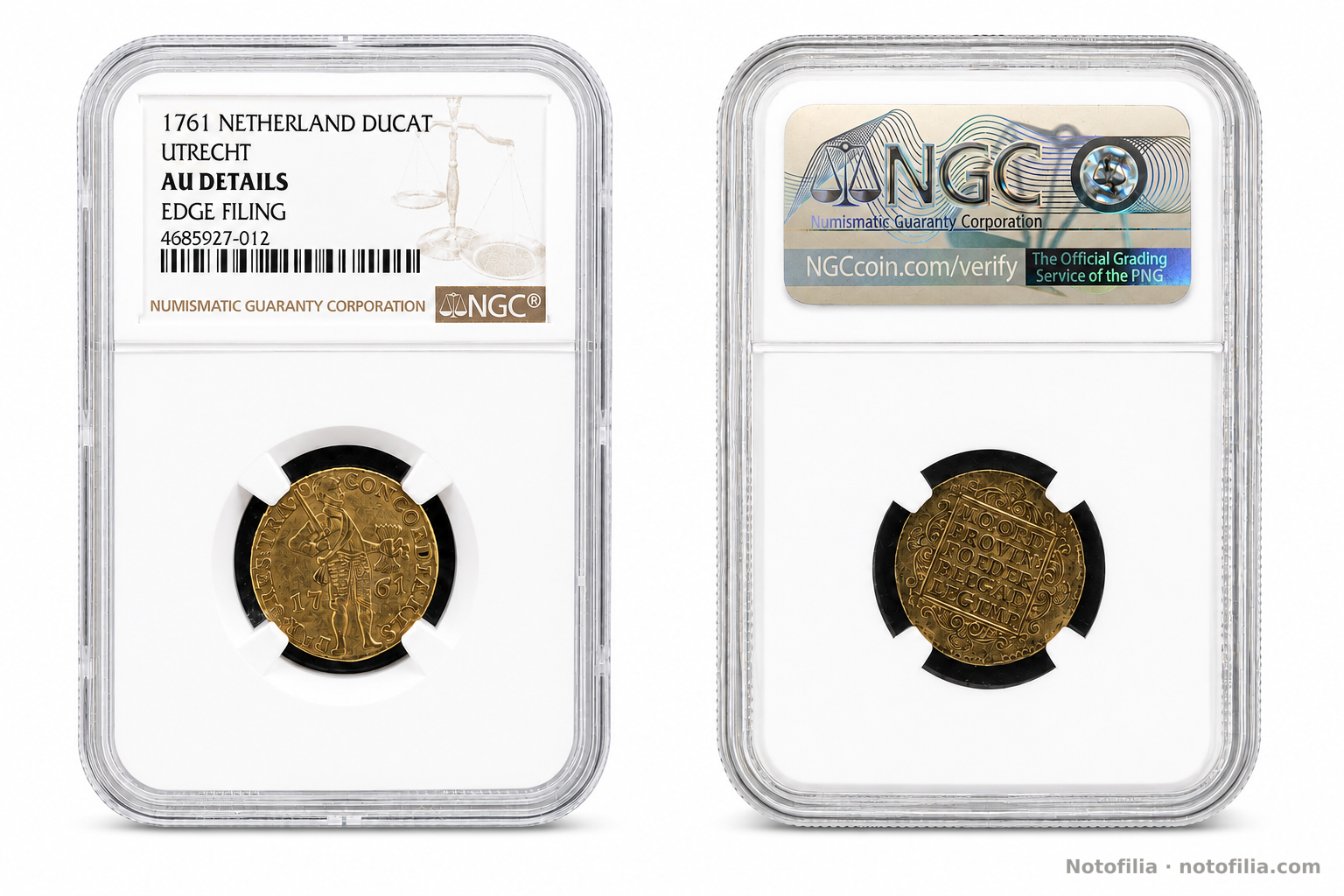
The provinces struck for themselves until Utrecht, from 1567, became the reference mint. The gold ducat, entered in the mint act on 4 August 1586, carried the knight with the bundle of seven arrows around the world. This case records a 1761 Utrecht ducat. The 1609 Wisselbank stabilized the metal; in 1806 Louis Bonaparte unified striking in that same city.
William I renamed the house ’s Rijks Munt. In 1817 the gulden became 100 cents. The silver 3-gulden yielded in 1840 to the 2½; provincial coins were withdrawn in 1849. The 1875 gold standard restored the 10-gulden; the square 5-cent of 1913 became one of the most recognizable twentieth-century types.
Occupation replaced billon with zinc; the United States struck pre-war-type silver for liberation. Bruno Ninaber van Eyben redesigned Beatrix’s series in 1982. Euro cash arrived on 1 January 2002; guilder coins could be exchanged at DNB until 1 January 2007. This country’s paper money is catalogued separately, under Notaphily.
Coins in the collection
One 1761 Utrecht gold ducat, slabbed by NGC. Further coin pages will be published as they are documented.
The catalog
Four chapters in one row, left to right by period: the medieval gulden, the trade ducat, the decimal gulden, and the changeover to the euro. Below, the ficha of the 1761 Utrecht ducat recorded in this collection.
9th c.–1567
From penny to gulden
From the Carolingian system to the 1434 gulden: the Dutch florin began as a silver unit on a par with the Italian gold florin.
Before 1434 the Low Countries followed the Carolingian system: a pound of 20 shillings and a shilling of 12 pennies. Local pennies appear from the ninth century and gros-tournois-style groats in the thirteenth; the Flemish grote depreciated faster than its French peers. In 1434 Philip the Good set the gulden at 20 stuivers — about 32.6 g of fine silver — on a par with the Italian florin, and the stuiver at 8 duiten. The name gulden, “golden,” remembers that equivalence. The sixteenth century added the gold Karolusgulden (1520) and the silver one (1541). Provinces and towns struck for themselves; that fragmentation is the starting point of the Utrecht mint.
1567–1813
Provincial mints and the ducat
Utrecht has struck since 1567; the 1586 gold ducat became a world trade coin. This collection records a 1761 example.
The Royal Dutch Mint traces its origin to Utrecht in 1567, when each province struck its own money. On 4 August 1586 the gold ducat entered the mint act as a trade coin: a knight with sword and a bundle of seven arrows, and the legend CONCORDIA RES PARVAE CRESCUNT. Fixed weight and fineness made it welcome from the Baltic to Asia; Russia and the German states even imitated it. In silver the leeuwendaalder, rijksdaalder, “silver rider” ducaton, and stuiver circulated. The 1609 Wisselbank slowed provincial debasements by assaying the metal. In the eighteenth century provincial mints — Utrecht among them — still issued copper duiten, stuivers, gulden, and 1- and 2-ducat pieces. This case records, from that period, the 1761 Utrecht gold ducat. In 1806, under Louis Bonaparte, striking was unified at the Utrecht mint.
1814–1940
The decimal gulden
William I renamed the mint ’s Rijks Munt; in 1817 the gulden became 100 cents and modern national coinage began.
In 1814 the unified mint was named ’s Rijks Munt. A second house in Brussels lasted until Belgian independence; from 1839 Utrecht was the kingdom’s only mint. In 1817 the gulden was decimalized: first the copper cent and the silver 3-gulden; in 1818 came the ½ cent, 5, 10, and 25 cents, the ½ and 1 gulden, and the gold 10-gulden. In 1840 silver was reduced and the 3-gulden yielded to the 2½ — the decimal-era rijksdaalder. Provincial coins were withdrawn in 1849. The 1875 gold standard brought back the 10-gulden of 6.048 g fine gold. The 5-cent went from silver to round cupronickel (1907) and then to the famous square piece (1913). Circulating gold ended in 1933; the ½ gulden in 1930. Popular names — stuiver, dubbeltje, kwartje, piek, riks — outlived decimalization.
1940–2002
Zinc, postwar, and the euro
The occupier struck zinc; the United States prepared silver for liberation; euro cash arrived in 2002.
In 1941 the occupier replaced pre-war billon with zinc 1, 2½, 5, 10, and 25 cents. A 1944 royal decree ordered silver 10 and 25 cents and 1-gulden of the pre-war type from the United States for liberation; the zinc was demonetized and melted. In 1948 the bronze cent and 5-cent returned with Wilhelmina; Juliana took the obverse from 1950. The silver gulden and rijksdaalder returned in 1954 and 1959 and went to nickel in 1967; silver was demonetized in 1973. The cent ceased in 1980. In 1982 Bruno Ninaber van Eyben redesigned the series with Beatrix’s silhouette; the 5-gulden coin arrived in 1988. Euro cash circulated from 1 January 2002. Guilder coins could be exchanged at DNB until 1 January 2007; most notes remain exchangeable until 2032. The mint, Royal since 1999, was privatized in 2016 and moved to Houten in 2020. It still strikes the gold and silver ducat as collector pieces.
Sources
-
Royal Dutch Mint — About us
(opens in a new tab)
Founded in Utrecht in 1567; central mint from 1806; Royal predicate in 1999; move to Houten in 2020.
-
Wikipedia — Royal Dutch Mint
(opens in a new tab)
1806 decree, ’s Rijks Munt, withdrawal of provincial coins in 1849, 1944 striking in the United States.
-
Royal Dutch Mint — Golden ducats
(opens in a new tab)
Entered in the mint act on 4 August 1586; knight, arrows, and CONCORDIA RES PARVAE CRESCUNT.
-
Wikipedia — Dutch guilder (coins)
(opens in a new tab)
1434 reform, 1817 decimalization, occupation zinc, postwar series, and coin exchange through 2007.
-
Numista — Utrecht gold ducat (N# 323147)
(opens in a new tab)
United Provinces trade type; reference for the 1761 piece recorded in the collection.
-
De Nederlandsche Bank — Exchanging the guilder
(opens in a new tab)
Guilder coins are no longer exchanged; the DNB window closed on 1 January 2007.