United Provinces · Utrecht mint
Gold ducat · Utrecht 1761
Trade ducat in .986 gold, slabbed NGC AU Details (Edge Filing), certificate 4685927-012. Knight with a bundle of seven arrows and the MO. ORD. PROVIN. tablet.
Catalog facts
- Year
- 1761
- Mint
- Utrecht (TRA · Traiectum)
- Denomination
- 1 ducat (6 gulden)
- Composition
- Gold .986
- Weight
- 3.47 g (0.110 oz AGW, Numista)
- Diameter
- 21.7 mm
- Edge
- Cabled or plain (Numista)
- Condition
- NGC AU Details · Edge Filing
- NGC certificate
- 4685927-012
- References
- KM# 7.4 · Fr# 285 · Delmonte G# 965 · Ver# 98.4 · HPM# Ut 27 · Numista N# 323147
Obverse and reverse
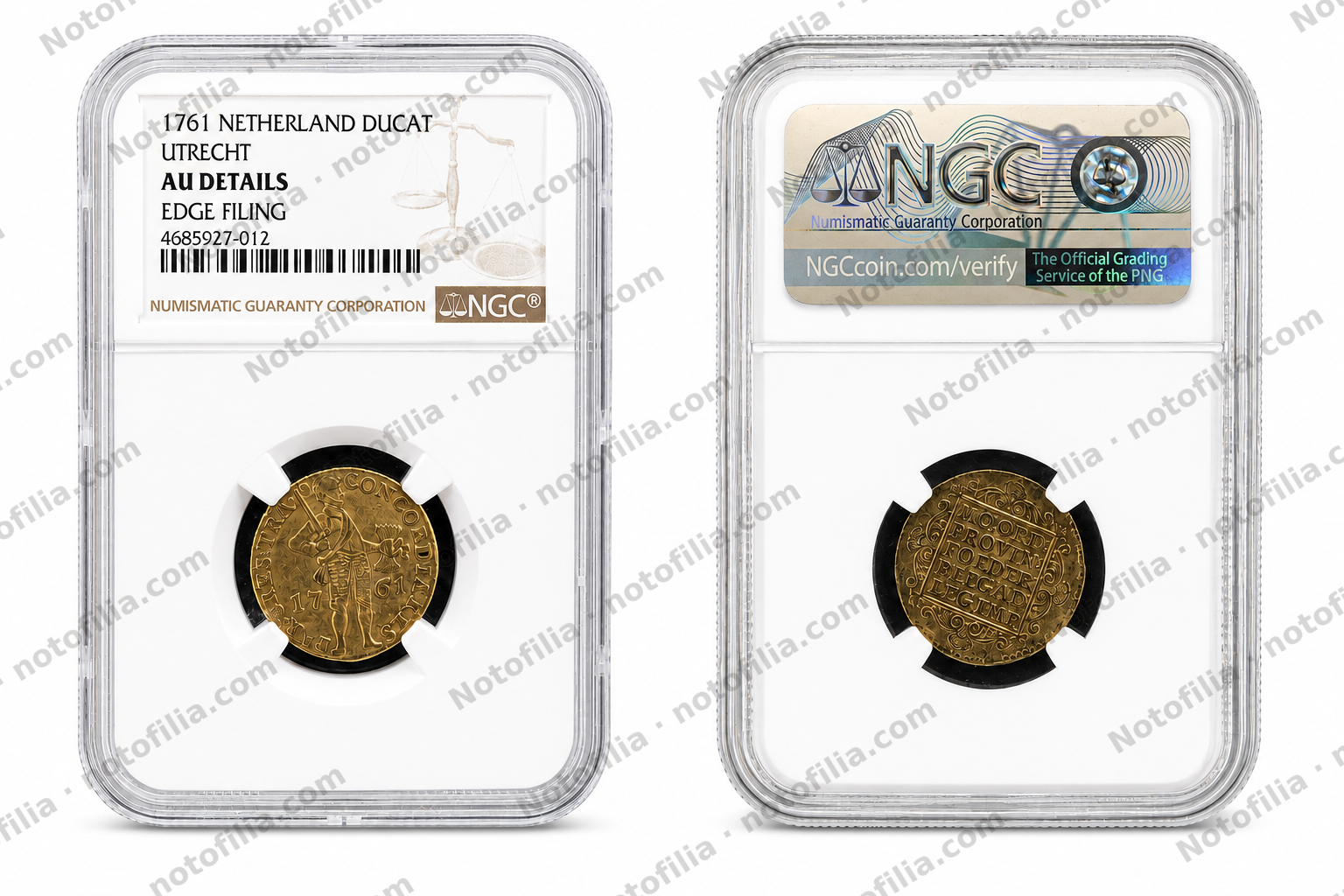
The coin
This 1761 piece was struck at the provincial mint of Utrecht, in the Republic of the United Provinces. The obverse shows an armored knight to the right, helmeted, sword raised and a bundle of arrows — the seven provinces — with the date split beside the legs (17–61). The legend CONCORDIA RES PAR. CRES. TRA. abbreviates Concordia res parvae crescunt Traiectum: “Through concord little things grow · Utrecht.” The Utrecht shield closes the legend as the mint mark. The reverse carries, on a square tablet with scrollwork, MO. ORD. / PROVIN. / FOEDER. / BELG. AD / LEG. IMP. — Moneta ordinum provinciarum foederatarum Belgicarum ad legem imperii: “Coin of the United Provinces of the Netherlands, in accordance with the law of the Empire.” Numista classifies this late obverse as KM# 7.4, Fr# 285, and Delmonte G# 965, a Utrecht type of 1739–1794: gold .986, 3.47 g, 21.7 mm, medal alignment. The edge may be cabled or plain. In account, one ducat equaled 6 gulden.
Legends
- Obverse
- CONCORDIA RES PAR. CRES. TRA. — Concordia res parvae crescunt Traiectum: “Through concord little things grow · Utrecht.”
- Reverse
- MO. ORD. PROVIN. FOEDER. BELG. AD LEG. IMP. — Moneta ordinum provinciarum foederatarum Belgicarum ad legem imperii: “Coin of the United Provinces of the Netherlands, in accordance with the law of the Empire.”
History
The gold ducat is one of Europe’s longest-lived trade types. The Royal Dutch Mint places its entry in the mint act on 4 August 1586: knight, sword, bundle of arrows, and CONCORDIA RES PARVAE CRESCUNT. Fixed weight and fineness — about 3.5 g of .986 gold — made it welcome from the Baltic to Asia; the Dutch East India Company (VOC) used it in overseas trade, and Russia and the German states even imitated it. On 19 November 1800 Governor Philip Gidley King’s New South Wales Proclamation valued a ducat at 9 shillings and 6 pence to keep coin in the colony, so the type also belongs among Australian proclamation coins. The royal mint still strikes the gold ducat as a collector piece, with the same knight-and-tablet scheme.
Scarcity and type
Numista gives the type (1739–1794) a rarity index of 84 among its members: 1761 is not a unique date, but the provincial gold ducat is collected as a trade coin, not as local billon. Edge filing — scraping gold from the rim — is common on ducats that circulated; NGC records it as Details and withholds a numeric grade. A 1761 AU Details population census is not independently verified here; this page records this certificate.
Certification
NGC authenticates the coin and describes the wear as About Uncirculated, but the Details designation for Edge Filing withholds a numeric grade. Certificate 4685927-012 identifies this holder. Edge filing is often a mark of real use: a little gold was scraped off without piercing the coin. It limits market value against numerically graded examples.
Sources
- NGC — Certificate lookup 4685927-012 (opens in a new tab)
-
Numista — 1 Ducat, Utrecht, late type (N# 323147)
(opens in a new tab)
KM# 7.4, Fr# 285, Delmonte G# 965, Ver# 98.4, HPM# Ut 27; gold .986; 3.47 g; 21.7 mm; years 1739–1794; value 1 ducat (6 gulden).
-
Royal Dutch Mint — Golden ducats
(opens in a new tab)
Entered in the mint act on 4 August 1586; knight, arrows, and CONCORDIA RES PARVAE CRESCUNT.
-
Downies — The Currency Proclamation of 1800
(opens in a new tab)
19 November 1800: a ducat = 9 shillings and 6 pence in New South Wales.
-
CoinVarieties — Utrecht 1761 ducat Fr-285
(opens in a new tab)
1761 date; Fr# 285; KM# 7.4; type 3.50 g, gold .986.
-
CoinWeek — A History of the Netherlands Gold Ducat
(opens in a new tab)
Origin in 1586, use in VOC trade, and continuity of the standing-knight type.
-
Wikipedia — Ducat
(opens in a new tab)
European trade type of fixed weight and fineness; the Dutch ducat as a successor of the Venetian model.
-
Royal Dutch Mint — About us
(opens in a new tab)
Founded in Utrecht in 1567; central mint from 1806; Royal predicate in 1999; move to Houten in 2020.
-
Wikipedia — Royal Dutch Mint
(opens in a new tab)
1806 decree, ’s Rijks Munt, withdrawal of provincial coins in 1849, 1944 striking in the United States.
-
Wikipedia — Dutch guilder (coins)
(opens in a new tab)
1434 reform, 1817 decimalization, occupation zinc, postwar series, and coin exchange through 2007.
-
De Nederlandsche Bank — Exchanging the guilder
(opens in a new tab)
Guilder coins are no longer exchanged; the DNB window closed on 1 January 2007.